People living in Kamloops are fortunate to share the landscape with six of the nine snakes found within BC. We have two types of garter snakes, the fast (and well-named) Racer, and the impressive Gophersnake and Rattlesnake; however, the most ancient member of the Kamloops snake community is the Rubber Boa, which also happens to be most cryptic member and, as a result, the least known.
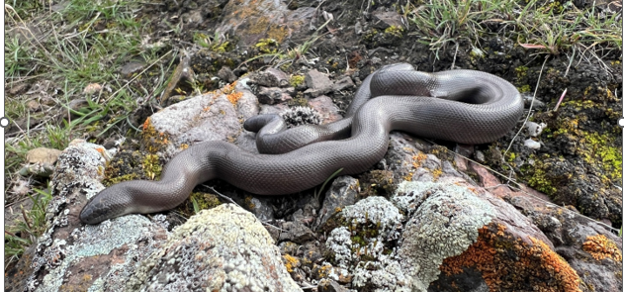
Our Rubber Boa is the most northern member of the Boa Family, which includes the monstrous Anaconda and Boa Constrictor of the tropics. However, a 30-inch Rubber Boa would be a very large example of the species. They are completely harmless, hunting small mammals like mice and voles, which they constrict in a fashion similar to their big cousins.
The Boa Family is an ancient lineage of snakes, and one of their most interesting features is that they still possess a pair of tiny spurs on their underside, that are actually the remnants of hind legs (it is generally agreed that snakes evolved from lizards).
A more tell-tale feature of the Rubber Boas is its blunt tail, which has led to the animal sometimes being referred to as the ‘double headed snake’. When cornered, the Rubber Boa coils up in a ball and may wave the tail like a head decoy.
Southern BC is the only part of Canada where the Rubber Boa can be found, but being cryptic and slow moving, the animal is seen not very often! From what we know, the snake spends a fair bit of its summer life under cover, and even when it is out in the open, its resemblance to a stick often tricks people into unknowingly passing it by.
The animal is considered ‘Special Concern’ under the federal Species at Risk Act (SARA), but the lack of data on the species here in Canada greatly hampers further conservation assessment.
How do you learn more about the Rubber Boa, when it is secretive and rare? The BC Boa Project, based at TRU, is attempting to do just this. Researchers are working to understand the life of the Rubber Boa in this northern region.
One of the objectives of the project is to understand if there are specific times of the day and seasons when these animals are more likely to be detected by inventory biologists. This summer, Rubber Boas are being radio-tracked in several parts of the province, including the Kamloops region, to understand their habitat choices, movements, and visibility at different times and conditions.
Because Rubber Boas are so difficult to find, community members who encounter the snake are asked to report their observation. This can be done in two ways: by emailing [email protected], or by going to the BC Reptiles & Amphibians webpage and filling out the reporting form.
Attaching a photo along with location data is extremely valuable, but no handling of the animal should take place. Please leave this harmless little snake alone! These reports help us better understand where and when the animals are observed.
The BC Reptiles & Amphibian webpage (www.bcreptilesandamphibians.ca) also is a great source of information on the charming little cousin of the Anaconda, and all the other snakes in our province. It provides images of all the snake species found in BC to help you distinguish between them. For Rubber Boas, however, just look for the solid colour and blunt tail!
Maria Collins is a graduate student at TRU studying the Rubber Boa.