
It took a quick tug of the handle on the bathroom drawer to propel me on a time-travelling trip, jettisoning me three decades into the past and plunking me down at a table for two at the iconic Club Villa restaurant in Abbotsford.
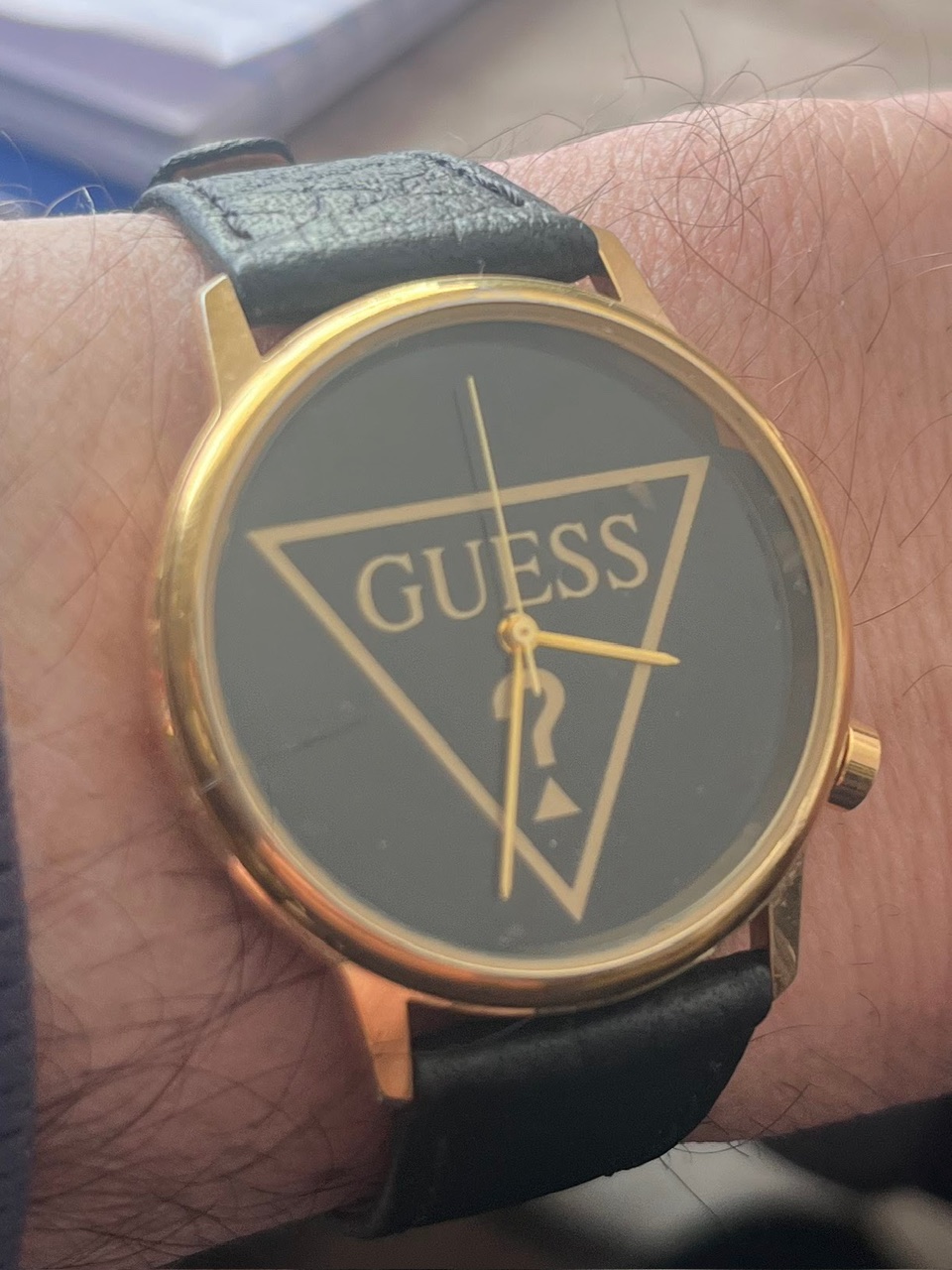
Searching through the bathroom drawer for a usable roll of dental floss, my fingers crawled over toothpaste and hair gel tubes, nail clippers and old razors. As I reached toward the back of the drawer, which resembled a shoebox-size version of the Sanford and Son junkyard, a glint of light reflected off something and caught my eye. It was brown and gold, featuring the familiar triangle logo that housed the quintessential 1990s brand name: Guess.
It was a wristwatch.
My oldest brother, Rick, gave me this Guess watch as a birthday present back in 1995. I was a cub reporter at the Abbotsford News, and we had met for lunch on my birthday, which was a Tuesday that year. It was a warm, sunny September day, and I was wearing cotton Dockers pants and a short-sleeved dress shirt, baggy as hell, per 1990s dress code (check out an episode of Seinfeld, circa season six, to understand that era’s sartorial sin).
We were smoking at the restaurant table, pre- and post-lunch, a memory that stands out in this era of no smoking in (or near) any building. After we ate, Rick pulled out a gift-wrapped box and a cupcake with a candle. In the box was the Guess watch. It reeks of the 1990s, of Chrétien and Clinton. I wore it for a bit, but not often because I did not usually wear watches. This was before the era of smartphones, so I relied on wall clocks wherever I went. Or the sun. It was definitely a slower time.
From September 1995 to now — 31 years — this watch has travelled from house to house and city to city in boxes and drawers, largely without me even realizing it was along for the ride. Finding it and touching it provided a tactile portal to the greatest of vacations: nostalgia, memories.
I mentioned my find to a good friend, who gets interested in a topic and does a deep dive into learning about it. One time it was suits. Another time, it was coffee beans and the perfect grind. When I relayed my Guess watch discovery, he was in the midst of a watch fixation, diving into the differences between mechanical, mechanical automatic and quartz, the advantages and disadvantages related to battery and mainspring power, the history of each, the barely perceptible differences in fractions of seconds lost per month, and the effect gravity and temperature have on different types of these time-keepers
The rabbit hole on watches is endless, for that seemingly simple round dial on your wrist is about as complex as time itself.
My Guess watch was bequeathed to me when the world was speeding toward its digital future with the launches of Windows 95 and eBay. The watch was my analog anchor — a steady, deliberate, mechanical heartbeat amid an era of zeroes and ones.
Upon rediscovering my timely partner, I had its battery and strap replaced and cleaned its face. I then placed it on my left wrist, secured the tang buckle into the adjustment hole and extended my arm as I gazed at its beauty. It felt different, but good. The strap is thinner than contemporary watches, which seem to have grown in size, to the point of gaudiness in some cases. This Guess watch is the understated uncle of today’s attention-seeking accoutrements.
I did some research and found that my watch was likely made in Japan in the early 1990s by Seiko, a company that made mid-level watches, all quartz. Now, quartz watches rely on batteries, but mechanical watches? Oh, boy. They are works of art. They have a wound mainspring and complex gears. They do not have a battery and require regular winding and servicing. Mechanical watches are the result of true craftsmanship and, lately, I have been looking at some of those creations. The good ones can run from about $700 to $1,500 before you get into rarified-air territory. And they tend to have wide, metal watch straps.
But I think I’ll stick with my blast from the past. Watching the hour and second hands march in a circle connects me to a time that no longer stands still, but delivers memories to me, via each tick and tock.
Submitted by Christopher Foulds