
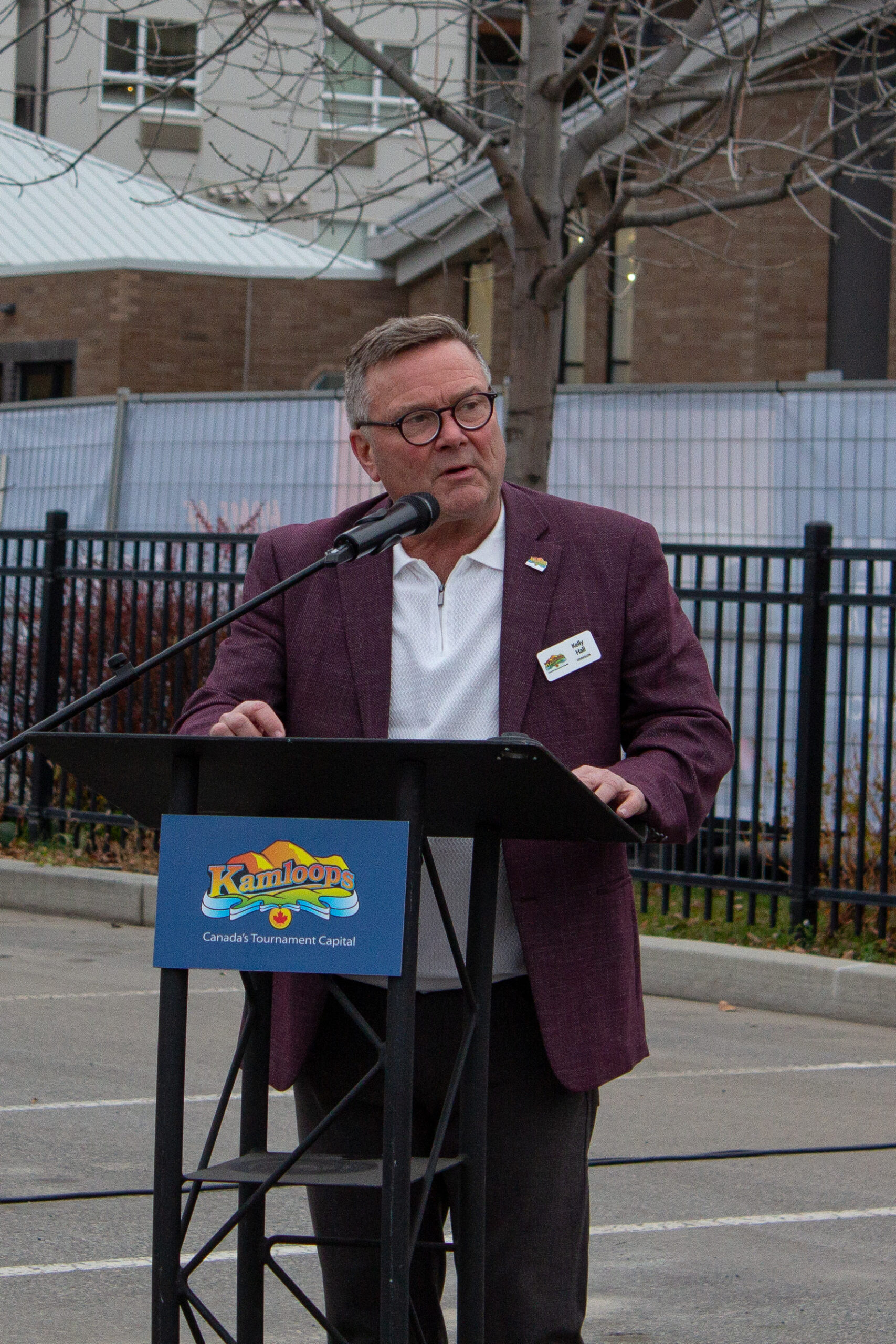
The ground has been broken for the Kamloops Centre for the Arts.
Nearly two decades in the making, construction of the performing arts centre will soon begin downtown at 393 Seymour St.
The project includes an 1,100-seat theatre, a 450-seat theatre, a lobby, cafe and gallery, and a two-level underground parkade with 158 spaces. Construction is expected to take nearly four years, with an opening date anticipated in 2029.
“The Kamloops Centre for the Arts will be a hub for creativity and connection. It’s going to provide a stage for local performers, a gathering place for our residents and a venue that attracts performers and visitors from near and far,” said Brenda Aynsley, chair of the Kamloops Centre for the Arts Society, which hosted the groundbreaking ceremony on Nov. 27.
The society was formed in 2019 by a group of local leaders, including those in the arts community, to advance a proposal by Ron and Rae Fawcett, whose philanthropy has been driving the centre’s creation.
After its formation, the society recruited more than 5,000 paying members, but before a referendum could be held, the pandemic derailed its efforts.
“Unfortunately, at the peak of the community momentum, we were forced to exchange our ‘vote yes’ signs for masks,” Aynsley told a crowd gathered at the Seymour Street lot.
But in 2024, Kamloops city council initiated the alternative approval process to seek the borrowing of up to $275 million to fund construction of the centre and other projects, including an arena multiplex in Dufferin.
The former site of the Kamloops Daily News has long been talked about as an ideal site for the KCA, though some, including Mayor Reid Hamer-Jackson, had other ideas, including an 11th-hour pitch to relocate the centre to River Street, just one day before the groundbreaking.
But city staff and councillors dismissed that idea.
Coun. Mike O’Reilly told the Chronicle the KCA’s downtown location will have economic spinoff effects, resulting in more business downtown.
“We already have an island on its own, the Sagebrush Theatre. There’s no economic spinoff. When people go to a show at the Sagebrush, they go there and then go home. Here, people will come early, they’ll go for a drink or an appy first, watch a show, have dinner. The spinoff we’re going to get from this is going to be significantly different than an island on its own that we have now,” O’Reilly said.
The 685-seat Sagebrush Theatre has long been home to Western Canada Theatre and other groups, but availability there for outside shows has been sparse.
Cultural services and events manager Dušan Magdolen said the need for more venue space is a longtime coming.
“Everybody knows Sagebrush is booked to the gills. The odds of somebody having a tour that has the exact day Sagebrush has available next month is slim to none,” Magdolen said.
Although the centre will be run by a third party non-profit, the city will still be involved in supporting the centre, especially in its early days, Magdolen said.
Confusion over funding, price already up
Earlier in November, council heard the price tag attached to the centre has risen to $211 million, about $45 million more beyond its initial costing. That includes an additional $23 million for a second level of underground parking.
Days before the groundbreaking on Nov. 27, City of Kamloops community engagement advisor Kristen Rodrigue clarified to council that all of the taxpayer funding related to Build Kamloops projects, including the KCA, has been secured already and is not impacting the current budgeting process, which is currently projecting a property tax increase of 10.76 percent.
“The project was part of the budget presentation last year. The funding strategy was presented for that, but there was some misunderstanding as to where we’re at. It has nothing to do with the 2026 tax year,” she said.
Rodrigue explained the only debt funding going toward the project is from what was approved via the alternative approval process. The remainder will be funded through the city’s reserves, existing funds and operating budgets and a community fundraising campaign.
“All of those costs are included in the funding strategy and there is no additional tax requirement to make this project a reality,” she told council.